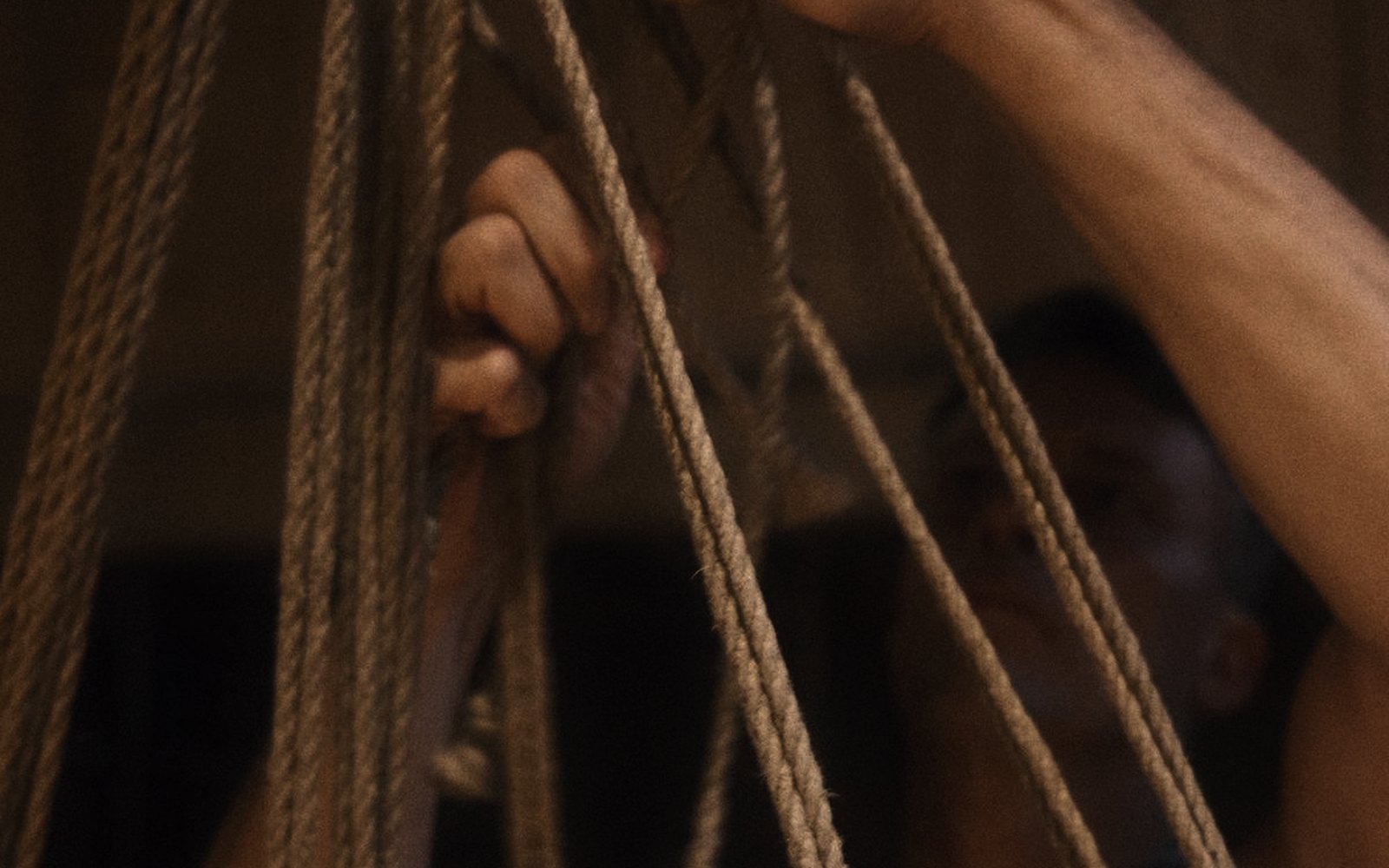
Learning shibari in Flanders
From your first knot to semi suspension. Free initiations in Ghent, classes in three levels in Eke, and private classes at your pace.
Learning shibari starts with curiosity. Maybe you saw a photo of rope patterns, or you heard that shibari brings couples closer together. Then come the questions: how do you begin, what do you need, and is it safe?
This page holds everything you need to start. From choosing your first rope to your first knots, from the safety rules to the tantric side that makes shibari so special to me. I have been giving workshops across Flanders for years and share here the knowledge I pass on to my participants.
Want to do something right away: every month I give a free introduction workshop in Ghent, and there is a free online course ready that you can begin tonight.
What is shibari
Shibari is the Japanese art of decorative and expressive tying with rope. The word literally means to bind or to fasten. Its roots lie in hojojutsu, the ancient Japanese martial art of binding prisoners. In the twentieth century that grew into kinbaku, the aesthetic and sensual tying of a partner.
Where many people associate shibari with BDSM, it is far broader. In my approach shibari stands for connection, trust and presence. The rope becomes a way to feel the other, to slow down, to arrive in the moment together. That is what makes it so powerful for couples and for anyone who wants to be more conscious about touch.
The person who ties we call the rigger or top. The person who is tied is the bunny or bottom. Both roles ask for practice, trust and communication, and in my classes you alternate between them.
More about this in the full guide shibari and tantra, and the history is in the article from hojojutsu to kinbaku.
Which rope do you need
The choice of rope makes a big difference in how shibari feels. There are three main types.
Jute and hemp are the traditional ropes. They have a natural grip on the skin, which keeps knots in place, and the texture feels warm and organic. I mostly use jute in private sessions, where I make, maintain and condition the ropes myself. Watch out with jute: much of it is industrial rope meant for packaging and contains JBO oil, which is not suitable for skin. See avoiding JBO in jute rope.
POSH, polyester over spun hemp, is a beautiful and expensive synthetic rope that feels natural and is easy to maintain. You can machine wash it, which makes it ideal for workshops where several people work with the same ropes. I use POSH in all my group classes.
Cotton will do, and I do not use it. It absorbs moisture and odours fastest, which makes it unhygienic in shared use.
For beginners I recommend rope of 6mm thick and 8 metres long. Start with two or three ropes, that is enough to learn your first ties.
You borrow rope from me in class, so you do not need to bring anything. At home you practise with your own set, and then it helps to have chosen rope that suits you.
If you want to go deeper, read the buying guide for shibari rope. You can buy it in the shop.
The basic knots
Shibari is about mastering a few fundamental techniques well, so you can work safely and creatively. These are the knots I start every beginner with.
- Single column tie. The first knot you learn. With it you bind a single body part, a wrist or an ankle, with a loop that does not tighten under tension. The safety is built in: however hard you pull, the loop does not get tighter. See the lesson on the single column tie.
- Double column tie. With this you bind two body parts together, two wrists or a wrist to an ankle. Like the single column tie, it is designed not to tighten.
- Frictions. A friction is a way to fix rope on rope by turning it around itself. Frictions are the building blocks of everything you do in shibari: they hold tension without hard knots. See the lesson on frictions.
- Lark's head. With this you join a new rope to an existing one when your first rope runs out, so you can keep working. See the lesson on joining rope.
Shibari is a language you learn to speak. Practise your knots in the classes and at the rope jams, because your hands learn it faster than any text. Have a look at the calendar or come to the rope jam.
Learning shibari as a couple
Shibari is above all a practice for couples who want to deepen their connection. It asks for something that daily life often buries: being truly present with the other.
As a rigger you learn to listen with your hands. Every movement of the rope is a question: does this feel good, is this pleasant, may I continue? As a bunny you learn to let go and trust. You hand over control because the safety and the holding feel so good that surrender comes on its own.
In my workshops I deliberately alternate those roles. Both partners experience what it is to tie and to be tied. That creates a mutual understanding many couples experience as a breakthrough.
What makes shibari special for couples is that it creates a clear frame for intimacy. There is a beginning and an end, there are agreements, there is attention. That frame makes it easier to feel and express things that are sometimes difficult in daily life.
Read what to expect at a first workshop, or have a look at the page shibari for couples.
Safety and consent
Safety is the foundation everything rests on. Without safety no trust, and without trust no surrender.
Physical safety. Before you start tying you learn about the places on the body where you need to be careful. Nerves and blood vessels on the inside of the wrists, the inner elbow, the groin and the neck are vulnerable. I would rather not teach you that through text on a site, for this you want to see the explanation on a body. Every class starts with a rope interview: you learn to ask questions about injuries, sensitivities and limits before a single rope is touched.
Consent and communication. We work with continuous check-ins. How does this feel, is anything tingling, do you want me to adjust something. We never work towards positions that hurt. The surrender we look for comes out of safety: when the bedding feels good enough, you can let go.
This is not a BDSM workshop. There is no punishment component and no dominance in the BDSM sense of the word. There is control, and that is the play of giving control and the art of loving. What do you need to be able to let go of in order to give control?
Safe material. Always use rope suitable for shibari, so no hardware store rope. Keep safety shears within reach so you can cut rope quickly.
Everything about this is on safety and consent.
Why shibari and tantra together
Tantric shibari is the approach I use in all my classes. It combines the technical side of rope work with tantric principles: breath, presence, energy and conscious touch.
In practice that means a second question alongside the first. Next to how do I lay this rope, also: what do I feel while I lay it? The rope becomes an extension of your attention. Every wrap is a touch, every friction a moment of contact.
That sounds abstract, and in the workshop you notice it immediately. When I ask participants to slow down, to breathe and to feel what happens under their hands, the whole energy in the room changes. It gets quieter. The attention shifts from am I doing this right to what do I feel.
I do not teach pure tantra. My specialism is tantric shibari, the combination of those two worlds. That combination makes it accessible to people who hesitate at the idea of a tantra workshop and are open to a creative, bodily experience with rope.
More about that approach on shibari and tantra.
How intense are the classes
In the classes L1, L2 and L3 and in the free initiation the clothes stay on. On the chili system they sit at level 1: we reach out, there is a soft touch and eye contact, and beyond that the focus is on technique and connection. The workshop days go further, and they sit higher on the scale.
Read how the chili system works and why I work trauma informed.
The ways to learn with me
There are six ways in, so you can choose what fits your level and your rhythm.
- The free online course. Theory and basic techniques through video and explanation, at your own pace. The ideal first step to find out whether shibari is for you. Start the free online course.
- The free initiation in Ghent. Every month at Freefall, where you only pay a contribution towards the venue. These fill up quickly. See the introduction workshop.
- Group classes in Eke near Ghent. Built up in three levels, L1 to L3. Fifty euro per person for three hours, with a discount when you book the three levels as a bundle.
- Private class for couples. At your own pace, without a group. Two hundred and seventy five euro for four hours, entirely tailored. You choose what you want to go deeper into.
- Group class at your place. Put your own group together, from three couples, and I come to you. From one hundred euro per hour, with online support afterwards.
- A session instead of a class. For those who would rather have a guided experience than instruction: the private session or shibari for couples.
L1: basics, knots, rope and connection
We start at the essentials: material, safety and the first knots. The aim is that you learn to play freely with rope as a way to improvise and to connect.
- Material knowledge: types of rope and how to care for them
- Basic safety: nerves, blood vessels and the rope interview with your partner
- Single and double column tie
- Working with frictions
- Introduction to one rope flow and improvisation
- First steps in emotion and connection with rope
Ideal for anyone who wants to start and to experience straight away how shibari can become a play of connection.
L2: harnesses, floor work and flow
Discover shibari as a dance: leading and following, tension and release. We build on the basics and bring movement, flow and emotional depth into your work.
- Basic harnesses: chest harness, futomomo and more
- Floor work: working dynamically with your partner on the floor
- Flow: from technique to improvisation
- Working consciously with rhythm, breath and energy
- Exercises to deepen trust and connection
For couples and partners who want to go beyond technique and experience the magic of connective shibari.
L3: semi suspension
Here you learn everything you need to work safely and consciously with partial suspension. Alongside the technique it is about the intensity and the surrender that arise when someone partly leaves the ground.
- Building solid harnesses suitable for semi suspension
- Working with lines, anchor points and body mechanics
- Transitions: moving safely from floor to semi suspension
- Physical and emotional safety in more demanding work
- Guarding trust and consent in more intense experiences
For anyone who wants to deepen their rope work and is ready to play with more intensity and power.
Prices
- Group class in Eke. Fifty euro per person for three hours. Several dates planned, with a discount on the L1, L2 and L3 bundle. A class can be cancelled if there are too few sign-ups.
- Private class for couples. Two hundred and seventy five euro for four hours. At your pace, you choose what to go deeper into, and no stress about keeping up with a group.
- Group class at your place. From one hundred euro per hour, cheaper from three couples. Can be at your home, you put your own group together, and there is online support afterwards.
New to the site? There is a fifty euro gift voucher for thirty in the shop.
Interested in a group class or a private class?
Leave your details and we will arrange a time
Upcoming workshops and classes
Frequently asked questions about the classes
Six formats, so you can choose what fits your level and rhythm: a free online course you can start right away, free introduction workshops in Ghent at Freefall, group classes in Eke near Ghent in three levels, private classes for couples at your own pace, group classes on location where you bring your own group, and sessions for those who would rather have a guided experience than a class.
No, not at all. The course starts at the absolute basics: material knowledge, safety and your first knots. You need no prior knowledge. There are also regular free initiations where you can get acquainted with no obligation.
The free online course lets you discover the theory and basic techniques at your own pace through video and explanation. The live classes go deeper: you practise with a partner, get personal feedback and experience the tantric side. Breath, presence and connection are learned only in physical practice.
Absolutely, the course suits couples especially well. Shibari is a powerful way to deepen connection and trust. During the classes you alternate between the role of rigger and bunny, so you both get to know the experience. There are also private classes specifically for couples.
Safety is central in every class. From the start you learn about nerves, blood vessels and how to hold a good rope interview with your partner. We work with continuous check-ins and adjust the ropes immediately to avoid pain. This is not a BDSM workshop. We work towards surrender without pain, in an atmosphere of respect and attention. More on safety and consent.
The group classes are in Eke near Ghent. There are also regular workshops at other locations across Flanders. Private classes can take place at your home. Check the calendar for the next dates, or leave your details through the form on this page.
The online course is free. Group classes in Eke cost fifty euro per person for three hours. Private classes for couples are two hundred and seventy five euro for four hours. There is a discount when you book the three levels as a bundle. Group classes at your place start from one hundred euro per hour, from three couples.
Nothing. In the group classes I work with my own POSH ropes, which go into the washing machine after every class. If you want to buy rope yourself, first read the buying guide.