Avoid JBO in Jute rope
JBO (Jute Batching Oil)is an oil that is often used during the production of industrial jute to make the fibers smoother and easier to spin. This oil is not intended for skin contact.
Always ensure that your jute ropes are JBO free.
- JBO (Jute Batching Oil) is an oil often used in the production of industrial jute to make the fibers more flexible and easier to spin..
- This oil is not intended for skin contact: it may contain chemical residues that can cause irritation or allergic reactions.
- Some JBO oils even fall under the category of PAHs (Polycyclic Aromatic Hydrocarbons), substances that can be carcinogenic with prolonged contact.
Why avoid JBO?
Health risks
The safety document from Petron Corporation regarding JBO states that hydrogen dioxide can be released when the oil is overheated, even in the presence of water. Heating above 70 degrees Celsius should be avoided as it can release toxic fumes that can cause respiratory failure, coma, or even death, sometimes without any noticeable odor.
Scientific research shows that the carcinogenic risk of JBO increases with skin contact. Studies where known carcinogenic polycyclic aromatic hydrocarbons were applied to mouse skin recorded 100% tumor formation over a period of twenty weeks. The tumors formed included benign papillomas, keratomas, and fibrosarcomas. The researchers concluded that JBO can be a complete carcinogen or a tumor promoter upon contact with the skin.
For rope that slides intensively over skin, this is very dangerous.
What exactly is JBO?
JBO is a mineral oil, produced by fractional distillation of petroleum. It is also referred to as white petroleum, mineral oil, or machine oil. It contains five more hydrocarbon atoms than regular gasoline, is more expensive than regular fuel, and is used as a lubricant and as an alternative to kerosene in aviation fuel.
It is popular for jute mills for one simple reason: it is cheap.
Why does it exist?
Raw jute fibers are stiff and difficult to process. For spinning yarn, the fiber needs to be supple, strong, and flexible. To achieve this, the fibers are soaked in a mixture of oil, water, and sometimes an emulsifier after being hackled. This process is called "batching." The fibers are then left stacked for a while so that the oil can fully absorb, which is referred to as "piling."
The oil remains in the yarn, and later in the rope. It is not decorative but structural: it maintains the flexibility, strength, and lifespan of the product.
JBO cannot be removed.
A persistent misconception in the shibari community is that rope can be sufficiently "clean burned" or boiled to remove the oil. This is not true.
Above 38 degrees Celsius, the smell may partially disappear, but the oil itself remains. Just like cleaning up oil spills at sea, it is only possible to completely remove JBO with a degreasing cleaner. Even after boiling, drying under tension, and post-treatment with tsubaki oil and beeswax, some people may still experience anaphylactic reactions.
If you hear rope creaking under load, it indicates fiber breakage. That sound means that the essential oil composition has been compromised or removed. Jute has a very low stretchability for breakage. Creaking rope that is stretched is unsuitable for body weight.
Ecological and ethical issues
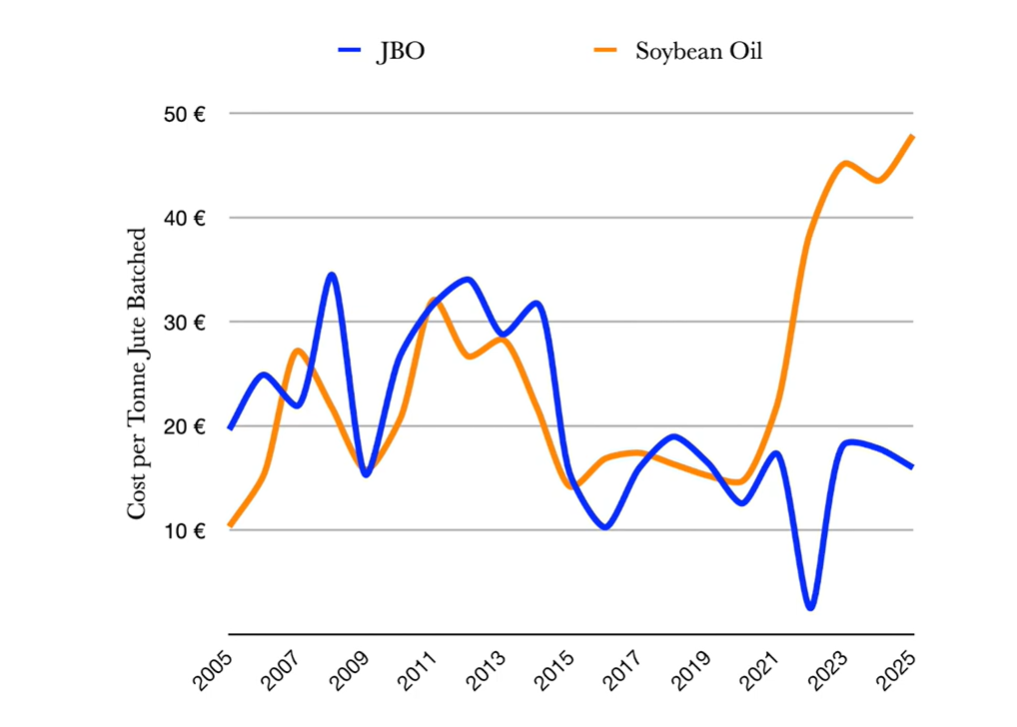
JBO is not biodegradable and is harmful to aquatic organisms. Vegetarian alternatives have existed for a long time. Soybean oil has been successfully used in jute batching since 1990, through a UNESCO program. The downside is cost: soybean-treated rope currently costs three times more per ton of raw fiber than JBO.
Palm oil is cheaper but contributes to deforestation, loss of biodiversity, and human rights violations. Rice bran oil spoils quickly. Castor oil and cold-pressed soy remain the most responsible choices.
Additionally, there is a market problem. Gardener's twine treated with JBO is produced industrially in China, heavily subsidized by the state, and purchased on a large scale by Japanese corporations that resell it to regular rope sellers. Those sellers often do not even know the origin. The result: JBO rope that is so cheap that fair production costs cannot compete.
What I use and why
The ropes I use in my workshops and sessions come from Koumanawa, a producer that controls the entire production process: from the raw fiber directly from the farmer, through heckling and spinning, to finishing with soybean oil treated under a UNESCO program.
Koumanawa confirms the absence of JBO through gas chromatography-mass spectrometry (GC-MS), a chemical analysis method that objectively maps the oil content of the rope. Zero result for JBO.
Dat is voor mij geen marketingkeuze. Het is een basisvereiste voor werk waarbij touwen langdurig en herhaald in contact komen met huid en lichaam.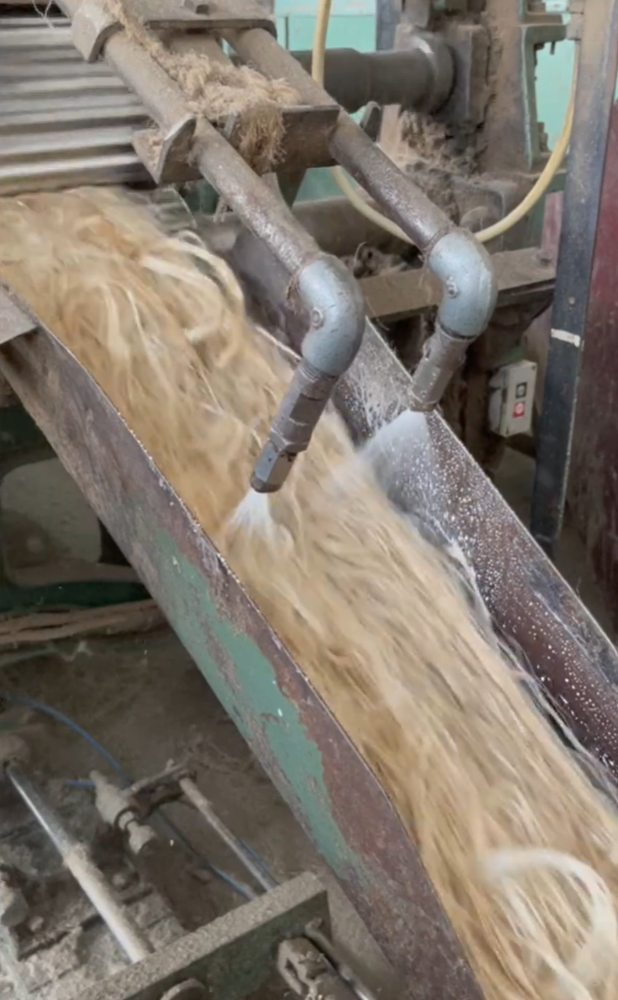
After the fiber is crocheted, it is dosed with a mixture of oil, water, and usually a small amount of emulsifier. It is then stored for a while so that the oil can fully absorb. This is called "piling."
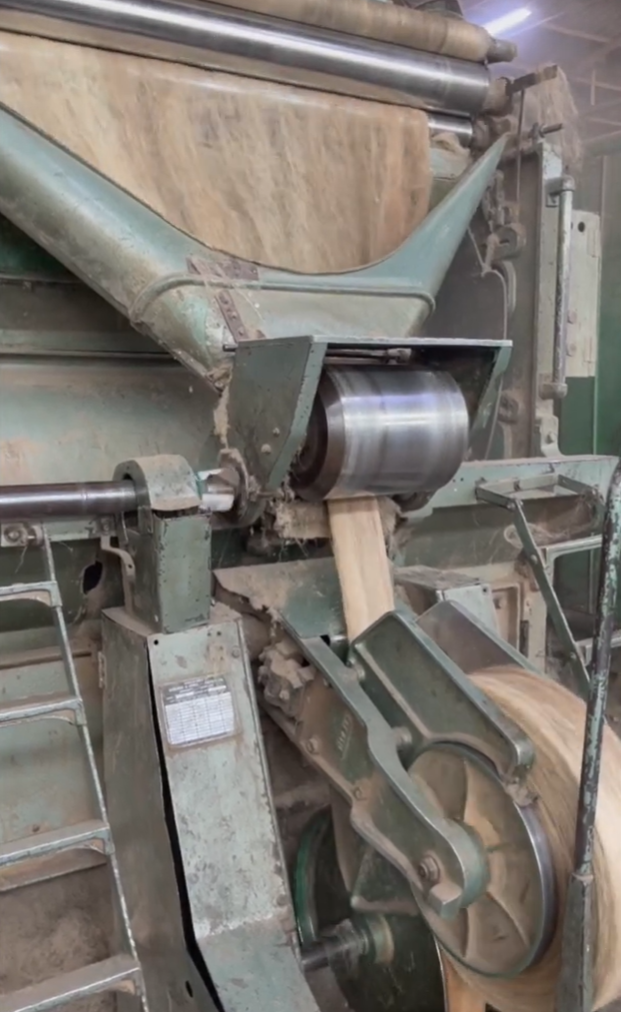
Oil is necessary to soften the fiber so that it can be processed and yarn can be spun. It plays a crucial role in maintaining the flexibility, strength, and lifespan of jute. Therefore, it cannot be removed.
Koumonawa uses cold-pressed soybean oil, which has been successfully used in jute batching since 1990 and is supplied through a UNESCO program. The cost per ton of jute fiber treated with soybean is currently three times higher than when using JBO., die al succesvol gebruikt wordt in jute-batching sinds 1990 en geleverd wordt via een UNESCO-programma. De kostprijs per ton jute-vezel behandeld met soja is momenteel drie keer hoger dan bij gebruik van JBO.
How do you recognize JBO in rope?
There is no simple visual test, but here are some clues:
- A petroleum or machine oil-like smell
- Rope that seems cheap in relation to its quality
- No transparency about the production process or origin
- Crackling sounds under load (but this can also have other causes)
If a seller cannot say where the rope comes from and how it has been treated, that in itself is information.
Touw kies ik niet alleen op gevoel of esthetiek. Het zijn de enige materialen in mijn praktijk die letterlijk om een lichaam heen gaan. Die keuze verdient hetzelfde zorgvuldige bewustzijn dat ik vraag in elk ander aspect van het werk.