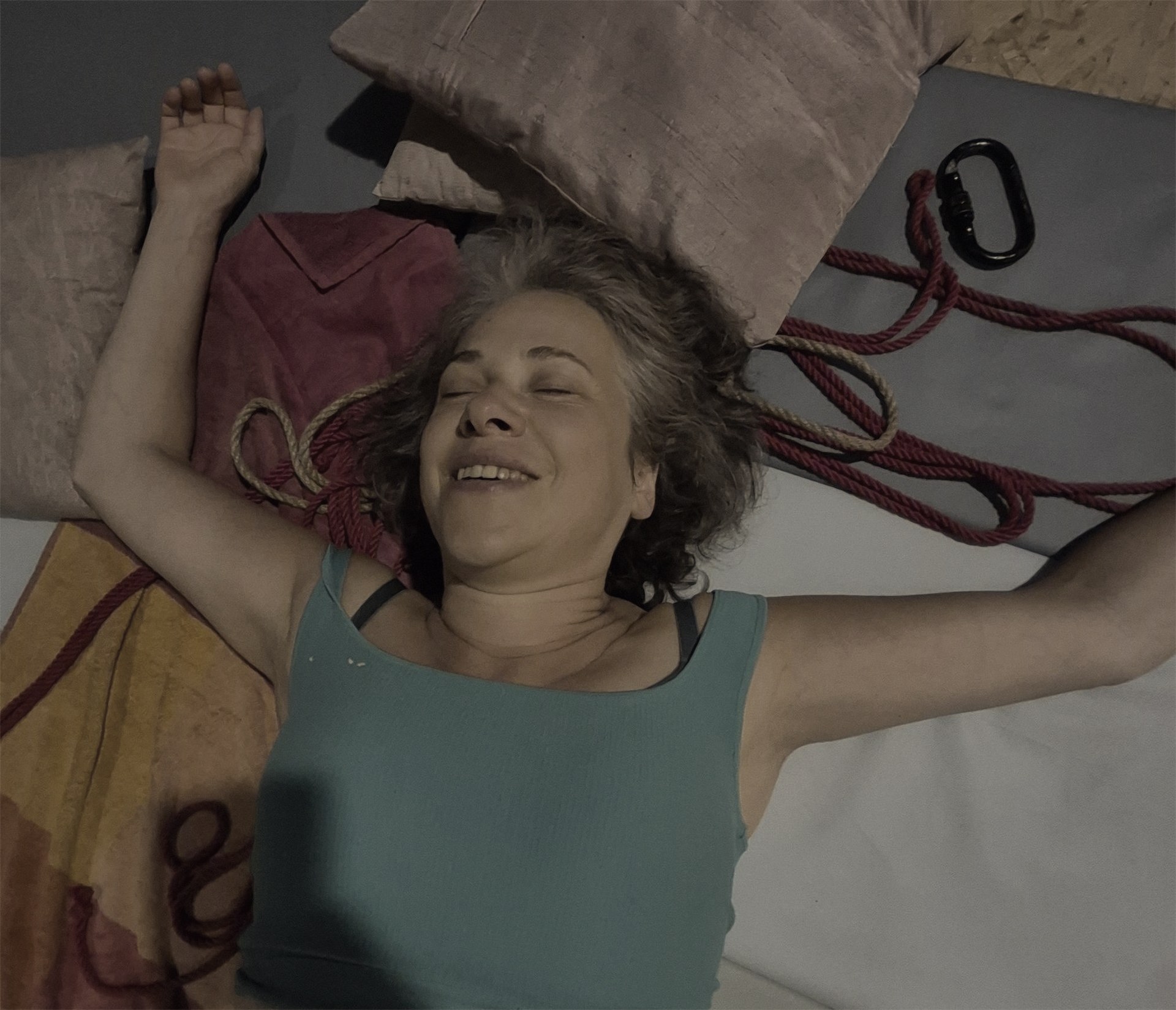
Getting out of your head
This way inward runs through your body, rope and presence. Not through thinking once more about why you think so much.
That endless stream of thoughts that will not stop. Worrying about tomorrow while you have not yet felt today. Analysing every situation until there is nothing left to feel. Your head spins, your body stands still.
I work with people who get stuck there. Bright, conscious people who understand everything and struggle to feel. Who can explain exactly what is going on and do not know how to let it go. Who meditate, journal, do breathing exercises, and still lie awake at night with a head that will not stop.
What I offer is not a theory in five steps. It is an experience so bodily, so present, that for a while your head cannot do anything but go quiet.
What being stuck actually is
Being stuck takes many forms. Some feel it as constant mental noise. Others describe it as tension in the shoulders, the jaw or the belly. Others again notice they have gone emotionally flat: they no longer cry, nothing moves them, they no longer feel themselves properly.
What those forms share is that the connection between head and body has weakened. The head takes over. The body waits. In that waiting the feeling of standstill arises.
Why thinking does not help
It sounds like a paradox and it is exactly the problem. You try to stop thinking by thinking. You analyse why you worry. You read a book about letting go and turn it into a new project. You try to meditate, and your head turns the silence into a meeting room.
For me the way out runs through the body. Your body knows a language older than words. A language of pressure and warmth, of rhythm and breath, of touch and surrender. That language never disappeared, it was only drowned out.
Shibari, the Japanese art of binding with rope, speaks that language. The rope touches your skin, you feel pressure in certain places, your breath changes. And suddenly you are in your body. Here. Now. Read what shibari is exactly.
What happens when rope brings you back
When someone is tied for the first time in a safe setting I nearly always see the same thing. For the first minutes the head is still present. Am I doing this right? How do I look? What is the next step?
And then something shifts. The rope gives pressure. Noticeable, not painful. That pressure works as a form of deep pressure stimulation that activates your parasympathetic nervous system. Your breathing slows. Your jaw relaxes. Your shoulders drop. It is as if your body finally gets the message: for now you do not have to do anything.
That is the moment when you no longer think you are present, but feel it. In your skin, in your muscles, in your belly. People describe it as fully landing, or as finally quiet in my head.
Why rope does this and talking does not
Four things make the difference.
- The rope gives a clear physical boundary. Where mental boundaries can be vague, rope is concrete. You feel it on your skin, and that concreteness pulls your attention straight to your body.
- The pace is slow. I work with attention for every wrap, every knot, every breath. For many participants that slowness alone is enough to notice how hurried their ordinary life is.
- There is nothing to perform. You do not have to lie beautifully, be strong or be flexible. You only have to receive. For anyone who is always switched on, that in itself is a radical experience.
- You are held. When the rope sits well and the safety is palpable, the nervous system softens. Not because someone tells you to relax, but because your body experiences that it may.
The tantric layer
Shibari on its own already does a lot. Combined with tantric principles it goes deeper. Tantra is in essence about being fully present. About stopping the flight from what you feel, and learning to allow it.
In my sessions I combine the structure of the rope with the attention of tantra. Working slowly. Following breath. Leaving room for what arises. Being present with what is instead of steering towards a result.
For people used to controlling everything that is confronting, and at the same time exactly what they need. Control is often the engine behind the endless thinking. When you learn to let control go in an environment that is safe enough, you discover that under all that thinking there is something else. Rest. Connection. Trust. More about shibari and tantra together.
Safety as the condition for surrender
I want to be clear about this: the surrender needed here cannot be forced. You can only invite it. And that invitation only works when the safety is complete.
We work with continuous check-ins. I keep asking. How does the pressure feel? Is anything uncomfortable? Do you want me to pause? That is not a protocol I tick off, it is the core of how I work. Every touch is consensual, every step is attuned, and we never work towards positions that hurt.
These are not BDSM sessions. The surrender that arises here comes from being held. From the feeling that someone is there, that you are listened to, that your boundaries are not only respected but actively asked after. For anyone used to always being switched on, always anticipating, that in itself is a breakthrough. The nervous system learns: here I do not have to be on guard. Here I may receive. Read how safety and consent are built in.
This is not therapy
I am not a therapist, and shibari does not replace psychotherapy, trauma therapy or medical care. If you are struggling with serious complaints, professional support belongs with that.
What shibari can be is a practice alongside it. A place where you have a bodily experience that teaches you to be in contact with yourself again. Many participants tell me afterwards that they can feel more clearly what is going on. Not because the session solves anything, but because the noise gets quieter for a while.
This is also not suitable if you are in the middle of an acute crisis, or if you hope for a quick solution to deep psychological complaints. For those situations I refer you to a therapist or doctor.
Who this is for
This practice can resonate if you recognise yourself in one or more of these points.
- You live mainly in your head. You analyse everything and feel little. People say you think too much and you know they are right, and you do not know how to stop.
- You struggle with letting go. Control feels safe, surrender feels frightening, and somewhere you know that surrender is exactly what you are looking for.
- You are looking for something that goes deeper than talking. Perhaps you have had therapy, coaching, read books. It helped and a bodily component is missing.
- You feel flattened, as if there is a pane of glass between you and your feeling.
- You want to feel connection again. With your own body, with a partner, with the moment.
You need no experience with shibari or with tantra. You only need to be willing to try something new. The offering is there for individuals and for couples.
Where you can begin
There are three ways in, depending on what you are looking for.
- The free introduction workshop in Ghent. Easy to walk into, free apart from a contribution to the room costs. A good way to get to know shibari and my way of working.
- A private session in Eke. One to one. Here I can zoom in on what you need, in a quiet setting with traditional ropes.
- The Untie Me retreat. A three day tantra retreat where surrender is the central theme and shibari is one of the roads there. For those who want more time and depth.
If you would rather come together, there is shibari for couples. And if you want to know beforehand how intense something is, every page says so with the chili system.
What to expect in a session
A session always starts with a conversation. I want to know where you are, what you are looking for and where your boundaries lie. There is no standard programme, every session is attuned to you.
Then we work with rope. Slowly, consciously, with continuous attunement. The rope is of high quality material and is cleaned after every session. In private sessions I work with jute or hemp, the traditional ropes that give a warmer experience. More about the different ropes.
A session usually lasts an hour and a half to two hours, including the closing conversation, because what moves deserves room to land.
You do not leave the session with a solution for all your thoughts. You leave it with a memory in your body of how silence feels. Of what it is to simply be there, without performing, analysing or controlling. That memory is more powerful than any insight. Your head can forget an insight, your body does not forget an experience.
Frequently asked questions
No. The introduction workshops in Ghent are meant for people who have never worked with rope. You do not need to know or be able to do anything.
Yes. You can come alone to workshops. We work in rotating pairs, or you can let me know you prefer to work with me as your fixed partner. Private sessions in Eke are always one to one.
Shibari has a sensual quality and it is not a sexual practice in my offering. I work with presence, touch and rope. What that brings up in you in terms of connection, intimacy or arousal is yours. My role is to hold a safe space.
In workshops I always use POSH ropes. They are machine washable and stay hygienic between workshops. For private sessions in Eke I use traditional jute and hemp, which give a different feel on the skin.
Then we stop. Always. You do not need to explain anything or make anything right. Consent is not a one time contract, it is an ongoing conversation.
Many participants describe a state softer than ordinary relaxation. The rope holds you, you do not have to do anything, and the body is allowed to sink into a held rest. Some people also feel emotions surface that they did not expect. That is welcome, I hold what comes up.
Yes. Many couples come together, sometimes to find something back, sometimes to discover something new. The workshops offer a safe frame to experience together what it is to give and receive control.
Shibari is not a therapy or a treatment. It can be a supportive bodily practice for people who live too much in their head or have trouble dropping into their body. The slow pace, the physical boundary of the rope and the feeling of being held help the nervous system soften.