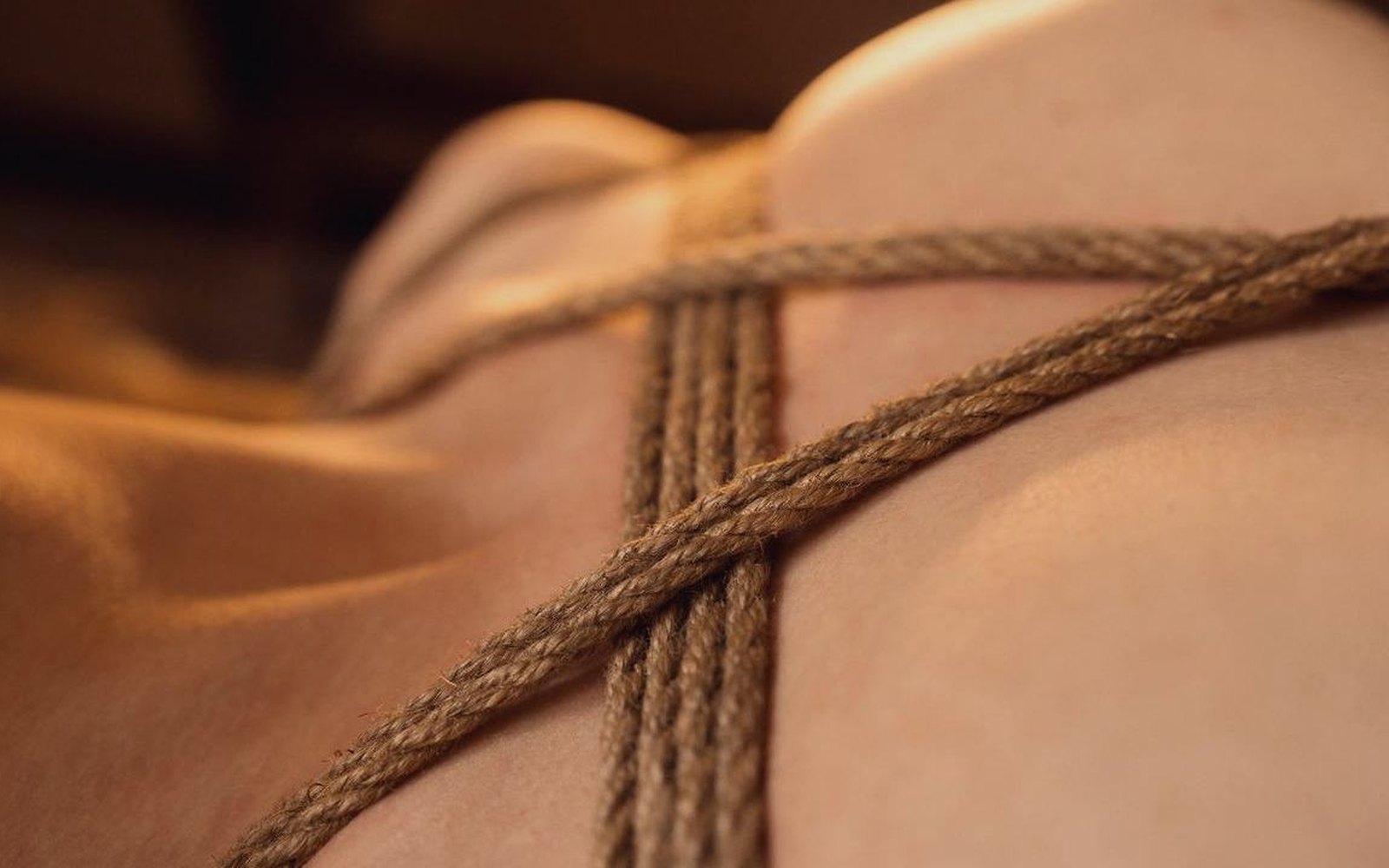
What is shibari? The art of connection through rope
I combine Japanese rope art with tantric principles. What arises I call bedding: a safe space in which you may let go of control without losing yourself.
Shibari in short
Shibari is the Japanese art of binding with rope. The word comes from the Japanese verb shibaru (縛る), which means to tie or bind. A rigger lays rope around the body of a model, in patterns that create tension, line and form. People practise it as an art form, as meditation, as intimate connection between two people, or within kink. Learning starts on the floor, with simple ties and a lot of attention to safety.
Shibari, kinbaku and the Japanese origin
Shibari has its roots in Japan. The predecessor is called hojojutsu, the technique samurai and law enforcers used to bind prisoners in the Edo period. Which tie someone received depended on their rank and their crime.
In the twentieth century kinbaku grew out of it, an aesthetic and erotic art form. Seiu Ito (1882-1961), a painter and photographer, studied the old ties and captured them in images. He is often called the father of modern kinbaku. After the war, magazines such as Kitan Club, founded in 1947, spread the technique further. In Japan a master of the rope is called a nawashi.
The difference between shibari and kinbaku is subtle. Kinbaku literally means tight binding and refers to the Japanese form with its own principles: asymmetry, tension, the line of the rope across the body. Shibari is the broader term used internationally. I use shibari because it is more accessible, and the intention behind my work is that of kinbaku.
When rope work travelled to Europe and America at the end of the last century, shibari became the common word there. In Japan itself people rather speak of kinbaku.
The full history is in my article from hojojutsu to kinbaku.
What happens when you are tied?
The soft, constant pressure of the ropes invites you to drop out of your head and descend into your body. It is an invitation to feel, to experience and to be. In that controlled, safe environment you get the chance to explore vulnerability in a way that heals.
After a while in the rope, many people describe a changed state they call rope space, sometimes rope drunk. The head goes quiet, time blurs and the body feels heavy and warm. That is why aftercare belongs to it: coming out of the rope calmly, drinking something, landing and sharing what you felt.
I give workshops and retreats in which the rope becomes a conversation without words, held with the hands, the breath and the body. It is about connection, far more than about a technique.
This is a practice in its own right, in which rope and conscious intimacy strengthen each other. The rigger ties, the model is tied, also called the rope bunny or rope bottom, and together something arises that neither could make alone. Pain is carefully avoided throughout.
Who is shibari for?
Shibari is there for anyone curious about a different way of touch and connection. You do not need experience, you do not need to be flexible, and you do not need to be in a relationship.
In my workshops I see couples who want to deepen their intimacy. Singles who are curious. People coming from yoga or meditation who recognise something in the attention to the body. And people who simply want to give it a try. There are no wrong reasons to begin, as long as you are willing to be present openly and respectfully.
Surrender as a gift
Surrender is the core of the experience and runs as a thread through every workshop I give. I know surrender in its other form too: I come from a world of combat sport, where surrender is taken by pinning and locking someone down.
Here it works differently. Surrender is a gift you receive, and it rests on trust. It is a puzzle in which I have to learn where I earn that trust, before a conscious yes can come.
Forms of shibari: from floor work to suspension
Anyone who starts, ties on the floor. That is called floor work, or newaza in Japanese. The model sits, lies or kneels, and the rope carries no body weight. This is where you learn the basics, and where most of the work happens.
In a partial suspension the rope carries part of the weight. In a full suspension, tsuri in Japanese, the model hangs entirely in the rope from a suspension point. That takes years of practice, knowledge of anatomy and a rigger who oversees every movement. It is the image you often see in photos, and it is only a small part of shibari.
Alongside these there is decorative rope work on the body, shibari as performance on a stage, and self-tie, in which you bind yourself.
The basic ties
A few ties you come across everywhere. The single column tie goes around one wrist or leg and is the first one you learn. The gote, or takate kote, binds the arms behind the back and is the classic chest harness of kinbaku. The futomomo binds the bent leg, tying thigh and calf together. How you lay them you learn with your hands, in a class. See learning shibari.
Which rope you need
A shibari rope is usually 6 to 8 metres long and around 6 millimetres thick. Traditionally it is made of jute or hemp, natural fibres that grip well and hold a knot. Synthetic rope such as POSH is softer and can go in the washing machine. I advise against cotton, because it absorbs moisture and stretches. Safety shears always belong with it, within reach. Read which rope you choose.
The many faces of shibari
Shibari is broader than the image you find through Google. I work mainly with three layers. Every face is real. What they share is the rope, and the invitation to be present with what is happening.
Shibari for couples
Sometimes touch becomes functional and a silence creeps in between you, often through the grind of everyday life. Rope can then be a surprisingly powerful path back to connection, because it invites you to return to the body, to conscious touch and presence. Many couples discover a new layer in their intimacy this way.
Read more about deepening intimacy with shibari, or book a session for couples.
Meditative shibari
The body has its own access to the present moment, sometimes more direct than sitting still. When I lay on the ropes slowly, the nervous system responds to the touch. Pressure on the skin activates the parasympathetic system, the part that takes care of rest and recovery. The breath slows, the shoulders drop, the jaw softens. Here the form is always in service of the feeling.
Read more about meditative shibari.
Kink and the darker sides
Desires that fall outside the standard story are a natural expression of life force. In a safe, conscious setting you get to know them. That way the energy you put into suppression comes back to you as calm and connection.
Read more about kink and the darker sides of tantra and about shadow work.
Where you meet this in what I offer
The combination of shibari and tantra does not live in a single workshop. It runs through everything I do, each time in a different dosage.
- Free initiation. A calm introduction to rope, clothes on.
- Shibari meets Tantra. A full day in which rope and tantric touch come together. Six times a year.
- The classes L1 to L3. Pure technique, so your hands know what they are doing.
- The rope jam. Practising together, monthly in Ghent.
- A private session. One on one, at your pace and around your theme.
- Untie Me. A retreat weekend with surrender as its central theme, in which shibari is one of the roads from shame to the unashamed body.
How deep it goes, and how you know beforehand
Every offering carries a number of chili peppers. They indicate what the intensity can be for your nervous system, from clothes on to nudity welcome. That way you know beforehand what you are stepping into, and you choose for yourself what fits you right now.
Read how the chili system works and why I work trauma informed.
Why I combine shibari and tantra
Tantra and shibari share a core: presence in the body, attention to the connection with the other, and the willingness to go beyond the familiar. In the tantric approach the rope becomes a language with which you can say what words cannot carry.
For a long time I searched for the form of dominance that belongs to me, and I discovered that I am a travel guide. I give direction and hold space at the same time. I read what happens in the body, I adjust, and I bring you back when you run ahead of yourself.
Safety and consent: the foundation
Safety carries everything I do. I work with continuous check-ins during the binding, with anatomical knowledge about nerves and pressure, and with rope I select myself. You set your limit and your pace, and you may stop at any moment without having to explain it.
A few fixed rules apply everywhere. Never rope around the neck. Tingling, a numb feeling or cold hands mean something has to change straight away, because in the upper arm and the wrist nerves run just under the skin. Safety shears are always within reach. And someone who is tied is never left alone.
Who you learn this from
Ever since I started jiujitsu more than twenty years ago, surrender has fascinated me. I came to see it as a gift, as a form of strength and freedom. Through BJJ and grappling I got to know the body, together with anatomy and safety. In 2019 I fell in love with shibari and went deeper through Ligatio, Duchy and a great deal of self study.
Get to know me on the page about me.
Where you begin
You learn shibari mostly with your hands and your body, in the practice itself. Every month I give a free introduction workshop at Freefall in Ghent, where you only pay a contribution towards the venue.
Have a look at the calendar, discover learning shibari, book a private session, or find your own rope in the shop.
Frequently asked questions
Shibari-tantra is the combination of shibari, the Japanese rope art, with tantric principles such as presence, conscious touch and surrender. The attention goes mainly to the connection between two people, beyond the technique of the knot. The rope becomes an instrument to get out of your head and into your body, in a safe bedding.
For many people shibari belongs to BDSM, and it also exists apart from it, as an art form, as meditation or as intimate connection. The way I practise and guide it, it is about connection, trust and conscious touch, without pain or punishment. Surrender does have a place, always from safety.
No. The introduction workshops are specifically for beginners. You do not need to know or be able to do anything, and you do not need to be flexible or in a relationship.
No. In group workshops you change rope partner, or you work on your own. For couples sessions you come together, of course.
All work with rope asks for attention to safety. In my workshops you learn to work safely from the start: where the rope must not lie, how you check circulation and how you get out quickly. We never work towards unsafe or painful positions.
That differs per offering, and you can see it beforehand from the number of chili peppers. The free initiation and the classes are at level 1, with clothes on. Shibari meets Tantra is at level 2 and Untie Me at level 3.
Every month I give a free shibari introduction workshop at Freefall in Ghent, where you only pay a contribution towards the venue. In Eke I give private sessions and technical classes at three levels. The workshop days are at changing locations across Flanders and the Netherlands.
Kinbaku refers specifically to the Japanese art form with its aesthetic principles of tension, line and asymmetry. Shibari is the broader, internationally used term. I use shibari because it is more accessible, and the intention behind my work is that of kinbaku: conscious and with an eye for beauty and connection.
Shibari comes from the Japanese verb shibaru, which means to tie or bind. In Japanese the word itself carries no erotic charge. For the art form, people in Japan rather use kinbaku, which means tight binding.
In workshops I use POSH ropes, because they are easy to clean after every session. For private sessions and deeper work I use jute and hemp, the more traditional ropes. I never use cotton, because it absorbs moisture and odours.
Yes. Many couples discover a new layer in their intimacy through shibari. I offer specific sessions for couples who want to start together, focused on connection, trust and conscious touch.