Who this is for
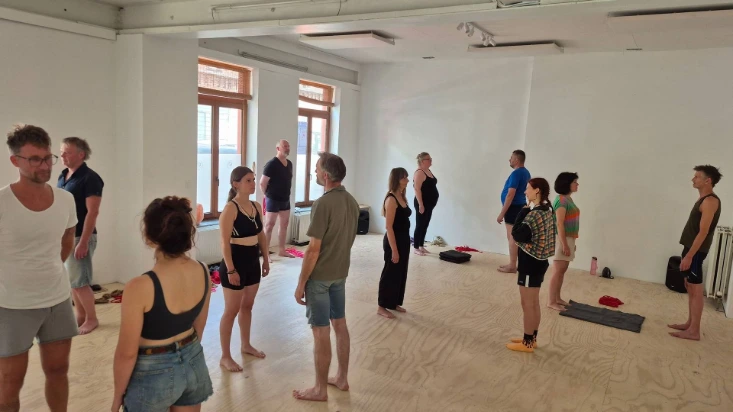
The introduction workshop is for anyone who is curious and wants to take the step from looking to experiencing. You need no prior knowledge. Most participants have never touched a rope in this context.
You can take part as a couple or on your own. If you come alone, you are paired with a rope partner for the exercises. That feels edgy to many people, and it is exactly what makes it powerful: you learn to give trust to someone you have just met, in a safe and guided setting.
The workshop suits you if you want to explore shibari as a conscious practice, if you want to deepen the connection with your partner, if you are interested in embodiment and consensual touch, or simply if you want to try something that takes you out of your comfort zone in a safe way.
This is not a BDSM workshop. We work without pain, dominance or submission. It is about trust, surrender and the art of being present with another person.
What you learn
The workshop lasts three hours and is built up in three phases.
Arriving and connecting
We start by sensing the group. In a short round everyone shares where they are and what their intention is for the evening. That lets me feel how much attention the basics of consent need, and it helps you arrive in the space. We do a short breathing exercise to get out of your head and into your body.
The basic techniques
You learn the fundamental knots and ties of shibari, always in connection with your rope partner. At every step you practise asking: does this feel good, is the pressure alright, may I touch here? That is the core of the practice. We work with continuous check-ins and adjust the rope immediately to avoid pain.
- the single and double column, the basic ties for arms and torso
- how to feel and regulate tension in the rope
- how to read your rope partner through body language and breath
- basic positions on the floor that are safe and accessible
Experiencing and integrating
The last part is less structured. You get room to experiment with what you learned, at your own pace. I guide individually and help where needed. We close with a short sharing round in which you can say what the experience did with you.
Safety and consent
Safety is the foundation everything rests on. My approach deliberately differs from what you may find elsewhere.
We work with continuous check-ins. I do not use a traffic light system here, I keep that for advanced classes. Instead we keep asking: how does this feel, is the pressure alright, do you want me to continue here? That makes consent an ongoing conversation rather than a one time agreement.
We never work towards positions that hurt. If something feels uncomfortable we adjust it immediately. The aim is a space in which you feel so safe and held that surrender comes on its own. That surrender is the most powerful thing you can give, precisely because it is voluntary.
Read more about my approach to safety and consent.
Which rope we use
In workshops I work exclusively with POSH rope, polyester over spun hemp. It is soft, has a pleasant grip on the skin and is easy to clean. After every workshop all the rope goes into the washing machine, so hygiene is never a worry.
Cotton is fine and a very soft rope, though I do not use it myself. Cotton absorbs moisture and smells the fastest, which makes it hard to keep hygienic in a workshop setting.
Jute and hemp are the traditional ropes. They have a rougher texture and, to my mind, give a deeper sensory experience. Because they are harder to clean, I mainly use them in private sessions. If you want to know more about the differences, have a look at the page on shibari rope.
How intense it is
In the introduction the clothes stay on. On the chili system this workshop sits at level 1: we reach out, there is touch and eye contact, and beyond that the attention is on technique and connection. What else is on offer goes deeper, and you can see that beforehand from the number of chili peppers.
Read how the chili system works and why I work trauma informed.
Practical
- Waar. Maandelijks bij Freefall in Gent.
- Cost. The workshop is free. You only pay a small contribution towards the venue costs. From 2027 I will ask 10-15€ on registration.
- Length. Three hours, including welcome, opening round and closing.
- Group size. About twenty participants. The introductions are popular and always fill up, so sign up in good time.
- Bring. Comfortable clothing you can move freely in. Short sleeves or a top work best, because rope grips better on bare skin. I provide all the rope, so there is nothing else to bring.
- Language. Dutch, and English when there are English speaking participants.
Have a look at the calendar for the coming dates. Unsure, or do you have questions? Get in touch with no obligation, I am glad to answer them before you decide.
After the introduction
The introduction workshop is a beginning. Many participants discover something in themselves they did not expect: a calm, a curiosity, a wish to go deeper. There are several paths from there.
- The Shibari meets Tantra workshop days, in which we go deeper into connection.
- Workshops specifically for couples.
- Concrete technique in small groups, through the classes L1 to L3.
- The monthly rope jam, to practise together with no programme.
- Working in a personal setting, through a private session.
And there is no pressure to continue. Some people come to one workshop and carry the experience with them as something special they did. Others come back and develop shibari as a regular practice. Both are good.