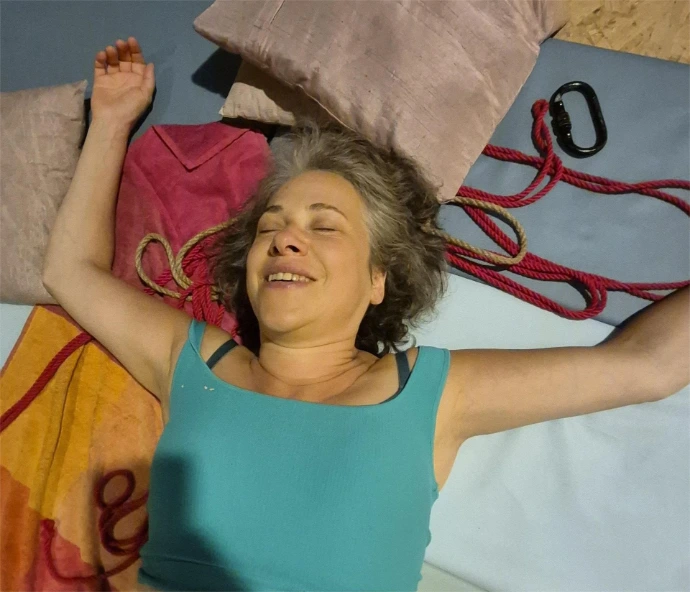
Shibari when you feel stuck: back into your body
This path inward does not go through thinking,
but through your body, rope, and presence.
On this page I explain how that works, who it is for, and where you can safely begin.
What does "stuck" actually mean?
What these forms share is that the connection between head and body has weakened. The head takes over. The body waits. And in that waiting, a sense of standstill arises.
How can shibari support this?
Shibari is not a treatment. It is an experience. But it is an experience with specific qualities that make it valuable for people who want to get out of their head.
The rope creates a clear physical boundary. Where mental boundaries can be vague, rope is concrete. You feel it on your skin. That concreteness draws attention immediately to the body.
The pace is slow. In a session or workshop, we move slowly. I work with attention to every wrap, every knot, every breath. That slowness alone is enough for many participants to notice how rushed their everyday life is.
There is nothing to perform. You do not need to look beautiful, be strong, or be flexible. You only need to receive. For those who are always "on", this alone is a radical experience.
The feeling of being held. When the rope sits well and safety is felt, the nervous system can soften. Not because someone tells you to relax, but because the body experiences that it may.
Is this therapy?
No. I want to be clear about that. Shibari is not a substitute for psychotherapy, trauma therapy, or medical care. If you are dealing with serious complaints, professional support is needed.
What shibari can be is a complementary practice. A space where, alongside any therapy, you have a bodily experience that teaches you to be in contact with yourself again. Many participants tell me afterwards that they can feel more clearly what is going on after a session. Not because the session "solves" anything, but because the noise quiets down for a while.
Surrender without pain
An important distinction: I do not work with pain. These are not BDSM workshops or sessions. We do not move into painful positions. We do not build catharsis through intensity.
What we do build is surrender through safety. The difference is essential. Surrender that comes from no longer being able to take it is something different from surrender that comes from feeling safe enough to let go. The second is what I offer. The body lets go because it may, not because it must.
During every session and workshop, we work with continuous check-ins. I ask ongoing questions: does this feel good, is there tension anywhere, can it be looser or tighter? Ropes are adjusted immediately if something does not feel comfortable.
Who is this for?
This practice can resonate if you recognise one or more of these: you notice you ruminate too much and struggle to be in your body; you find it hard to let go, to receive, or to do nothing; you feel flat, as if there is a layer of glass between you and your feelings; you long for deeper intimacy, first with yourself, possibly later with a partner; or you are simply curious what it is to be present without a task.
This practice is not appropriate if you are in an acute crisis, or if you hope for a quick fix for deep psychological complaints. For those situations, I refer you to a therapist.
What happens in a session or workshop?
Every workshop begins with a short check-in where we sense where everyone is and what their intention is. That gives me the chance to feel whether the group needs extra attention to the basics of consent and attunement.
After that I work with themes that help you feel what is alive in you around control and letting go. Sometimes via an animal theme, where you experience how control feels in the play of prey and predator. Sometimes via shame, or stillness, or touch through rope.
The goal is always the same: to give you an experience in which thinking can step back, and the body can come to the front.
Where can you start?
There are three paths, depending on what you are looking for.
Monthly introduction workshop in Ghent (Freefall). Low-threshold, free apart from a contribution to the venue costs. A good way to get to know shibari and my way of working.
Private sessions in Eke. One-on-one. Here I can zoom in more deeply on what you need, in a quiet setting with traditional ropes.
Bind Me Los retreat. A tantra retreat weekend where surrender is the central theme and shibari is one of the paths towards it. For those who want more time and depth.
In closing
The feeling of being stuck is, for many people, a sign that something wants to move. Not necessarily something that is wrong, but something that asks for attention. Shibari can be a way to give that attention, at a slow and safe pace, in a body that is finally allowed to be at the front again.
If you are curious, come and meet me at an introduction workshop. Or send me a message for a private session. No pressure, just a first step.
Disclaimer: Shibari in my offering is a supportive bodily practice, not a form of therapy. For serious psychological complaints, I refer you to a qualified therapist or doctor.
Frequently asked questions
No. The introduction workshops in Ghent are specifically meant for people who have never worked with rope. You do not need to know or be able to do anything.
Yes. You can come alone to workshops. We work in rotating pairs, or you can let me know you prefer to work with me as your fixed partner. Private sessions in Eke are always one-on-one.
Shibari has a sensual quality, but it is not a sexual practice in my offering. I work with presence, touch, and rope. What that brings up in you in terms of connection, intimacy, or arousal is yours. My role is to hold a safe space.
In workshops I always use POSH ropes. They are machine-washable and stay hygienic between workshops. For private sessions in Eke I use traditional jute and hemp ropes, which give a different feel on the skin.
Then we stop. Always. You do not need to explain anything or make anything right. Consent is not a one-time contract, it is an ongoing conversation.
Many participants describe a state softer than ordinary relaxation. The rope holds you, you do not have to do anything, and the body is allowed to sink into a kind of held rest. Some people also feel emotions surface that they did not expect. That is welcome. I hold what comes up.
Yes. Many couples come together, sometimes to find something back, sometimes to discover something new. The workshops offer a safe frame to experience together what it is to give and receive control.
Shibari is not a therapy or treatment. It can be a supportive bodily practice for people who live too much in their head or have trouble dropping into their body. The slow pace, the physical boundary of the rope, and the feeling of being held help the nervous system soften and allow presence in the body again.